Unlocking Resin Post-Processing: An ROI Story

Resin 3D Printing has offered many industries like dental and medical an opportunity to create parts they never thought were possible with other 3D printed materials. Resin provides many advantages over other 3D print technologies, such as a better resolution, faster printing, and stronger printed products. However, with all these advantages, there are also problems when post-processing resin. Our patented solution offers resin printers the opportunity to get back the money they could waste in the last step of their resin workflow.

Traditional Resin Post-Processing

Traditional resin post-processing has many drawbacks. Workflows can require multiple steps, including soaking parts in multiple tanks, scrubbing or cleaning with brushes, and focused cleaning with squeeze bottles. With traditional methods, manual labor causes increased technician attendance time. These processes also typically use generic solvents not designed for additive manufacturing, such as isopropyl alcohol (IPA)

IPA can also create a hazardous work environment for employees because of its highly reactive nature and low flashpoint. These methods do not allow organizations to scale their additive operations because they are time-consuming and offer inconsistent results, not to mention the additional environmental concerns and requirements with using IPA. Using IPA for resin removal can cut into your bottom line and ruin your ROI.

PostProcess Resin Removal Solutions

We have designed post-processing solutions that help increase your throughput, efficiency, and ultimately your ROI for resin printing. How do we do this?

Increased Productivity

Our resin removal solutions offer quicker cycle times than the traditional methods detailed above. Our proprietary software promotes consistent and repeatable results, so you won’t have to worry about reprinting.

Detergents Designed for Additive

Our in-house detergents are formulated specifically for additive manufacturing and offer a higher resin capacity than IPA. With this increase in capacity, the chemistry needs fewer changeouts and has a lower disposal frequency. Your post-processing solution will provide you with higher throughput because of less machine downtime and reduced waste generation. Our PLM-403-SUB detergent, used for our resin removal solutions, complies with ISO 10993 for biocompatibility. This means if you are printing for dental, medical, or audio applications, your prints will be biocompatible after processing.

Improved Efficiency

Automating the post-processing step of your resin workflow will help you increase the efficiency of your additive workflow. On average, PostProcess resin removal solutions beat traditional processes in both processing time and technician time. After thousands of tests, our solutions take, on average, 10 minutes to clean a batch of resin-printed parts. Compare this to an average of 20 minutes with traditional post-printing methods. Technician time is significantly less, from 10 minutes to 2 minutes on average.

ROI Calculations: The Basics

Before we delve into real-world ROI calculations, let’s look at the considerations when calculating our ROIs. We ‌look at the client’s current operation, which includes total print costs, and what portion of these costs are for post-processing: labor costs, the time spent processing each part, and the percentage of parts that come out warped or damaged, to name a few. We then compared these numbers to what post-processing costs would look like with implementing a PostProcess solution. The result is an ROI unique to each specific operation.

ROI Calculations

A client wanted to improve their resin removal post-printing operation. Because of the size and scale of their process, our team suggested the DEMI 430 resin removal solution.
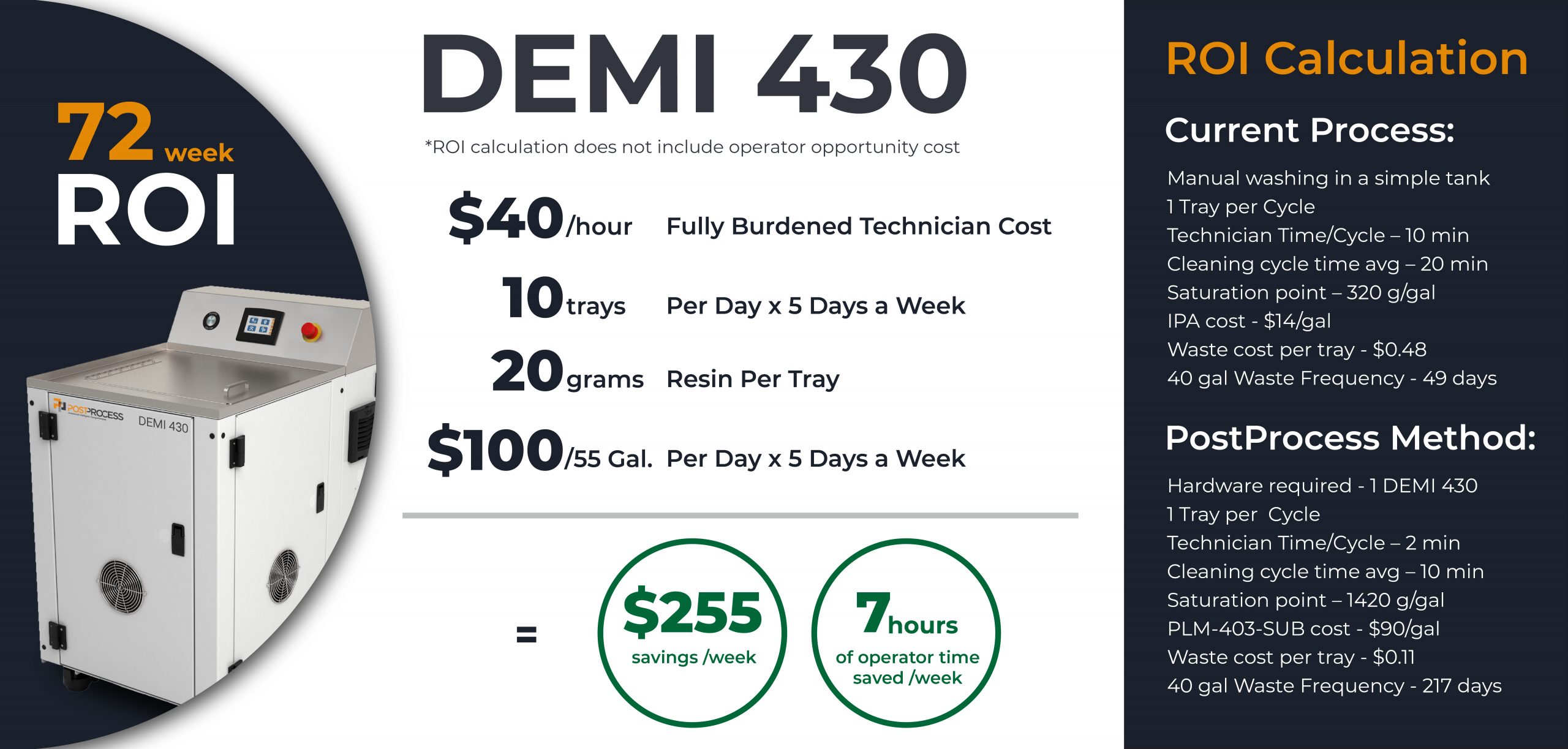
ROI chart breaking down cost savings from post-processing resin with the DEMI430

They originally used traditional post-processing methods, which required them to submerse parts in multiple IPA baths. Limited capacity and cycle time created a bottleneck in their workflow. Using IPA caused a significant burden for the customer because it required frequent changeouts. Once the PostProcess solution was implemented, our customer saw a decrease in both cycle time and chemistry changeouts, along with an increase in throughput.

How it Works: Automated Resin Post-Processing

Now that we’ve run through the real-life quantitative results that PostProcess solutions can achieve, let’s explore the technology behind these results and the benefits it offers.

At the heart of the DEMI family of resin removal solutions is our patent-pending Submersed Vortex Cavitation technology.

Key components in our resin removal technology include:

Proprietary Detergents

We specifically engineered PostProcess detergents for additive manufacturing. The detergents dissolve soluble support material or uncured resin without compromising the build material.

Vortex Pumping Scheme

Our solutions use a strategic pumping scheme that creates a proprietary rotating motion of the part while submerged in the detergent. Regardless of density or geometry, the technology will ensure that it uniformly exposes the part to the detergent and cavitation from the ultrasonics.

Variable Ultrasonics

Our solutions use ultrasonic-generated cavitation as another form of mechanical energy to optimize the chemistry. The ultrasonics emit sound waves at varying frequencies and amplitude, creating waves of compression and expansion in the detergent. This agitation of the liquid causes microscopic bubbles (referred to here as cavitation) to form on the surface of the part. The bubbles agitate support material as the chemistry weakens it, accelerating the processing time.


Our post-processing solutions help our customers overcome the bottlenecks and problems associated with traditional post-printing techniques. We do this with our patented hardware, proprietary software, and additive-specific detergents. Combined with our AUTOMAT3D™ software that helps users optimize the exact ‌time, temperature, and agitation. Our resin removal solutions deliver precise, hands-free post-printing for additive manufacturing workflows.

The Rise of Sustainability in Additive Manufacturing Post-Processing

Sustainability for businesses has been a hot-button topic in recent years. Around the globe, companies strive to reduce their carbon footprint and increase their sustainability practices. Which begs the question: What leads to this push for sustainability in business? And how can we, as additive manufacturing post-processing pioneers, help contribute to our customer’s sustainability goals?

Climate Change on A Global Scale

Scientists have shown greenhouse gas emissions contribute to many concerning events and changes in the global climate. This has caused a movement in the past ~10 years for corporate responsibility in business and sustainability in business practices. To understand exactly why there’s an increase in demand for sustainable business practices, we need to discuss what spurred this desire for sustainability.

Back in 2013, The UN Intergovernmental Panel on Climate Change (IPCC) published its Fifth Assessment Record about the ongoing global warming crisis. This data clarified just how heavily human activity affected climate change and inspired the 2016 Paris Agreement. The focus of the Paris Agreement was and still is to keep the temperature rise below a 2°C increase in the 21st century (preferably to 1.5°C). Actions to reach this goal involve significantly reducing carbon emissions and fossil fuel consumption. Climate change then became a hot-button topic and led to an increase in global initiatives to turn the tide on how humanity is managing its resources.

Following the Paris Agreement, sustainability became a major focus in the global business marketplace. Customers valued sustainability so much that over 90% of CEOs acknowledged it was fundamental for a successful business. As pioneers in the 3D post-processing industry, we were aware of our responsibility to build a sector that is eager to act upon sustainability initiatives.

Sustainability in Post-Processing

We feel it is our responsibility to keep this in mind when developing our post-printing solutions. It’s not only important to us, but to the entire additive manufacturing industry‌. Sustainability has always been a consideration for our customers, with 65% stating in our 3rd Annual Post-Printing Survey they would like to increase their health, safety, and sustainability factors in their post-printing operations.

So how do we do this? We keep sustainability in mind for every step of our patented three-step approach to post-processing. Our software-driven automated technology improves workflow efficiencies while reducing energy and chemical usage. Our detergents offer a significant advantage over traditional methods, with some solutions lasting 6X as long as traditional solutions. The recent launch of CONNECT3D® aligns with our sustainability goals, helping users with important tasks like recipe generation that will help them with optimum processing time and detergent usage.

To us, the most significant value in our solutions is a human-centric one—the reduced time spent on manual labor. Traditional post-printing requires tedious hands-on labor to complete support removal or surface finishing without our automated solutions. These inefficiencies can negatively affect a company’s overhead because of the energy that technicians and engineers are wasting on post-printing. Instead, these individuals should be able to use their full potential to work on more fruitful projects. It’s no surprise that excessive manual labor can negatively impact overall health and well-being.

People. Planet. Profits.

Our sustainability initiatives do not end with our products, though. Sustainability is at the heart of our company, and we are continually striving to incorporate more of it into our day-to-day operations. Much like we focus on an integrative 3D printing approach based on the three steps of design, print, and post-print, we root our commitment to sustainability in a three-pronged approach: People. Planet. Profits.

At PostProcess, we use the United Nations’ 17 Sustainable Development Goals to help guide our sustainability approach. We strive to incorporate all 17 goals into the foundation of PostProcess Technologies, pulling out three to focus our initiatives around:

  • Goal 3: Good Health & Wellbeing: Ensure healthy lives and promote well-being for all.
  • Goal 8: Decent Work & Economic Growth: Promote sustained, inclusive, and sustainable economic growth, full and productive employment, and decent work for all.
  • Goal 12: Responsible Consumption & Production: Ensure sustainable consumption and production patterns.

Sustainability is crucial to the future of our planet. We feel it is our company’s responsibility to ensure that all of our post-processing solutions have the concept of sustainability at the heart of everything we do. If you’re interested in learning more about our sustainability efforts or our post-processing solutions, be sure to explore our post-processing solutions.

Automating Resin Removal for Dental Applications

3D printing has a myriad of benefits for industries like consumer products, automotive, and aerospace. But additive manufacturing’s (AM) ability to manufacture custom designs with optimal accuracy gives it a special leg up in medical and dental applications. In fact, estimates project the total 3D printing market size for dental to reach $26.1 Billion Dollars this year, due in part to the roughly 50% of dental patients who have not visited the dentist since the start of the pandemic. With such substantial projected growth, it’s imperative for those in the dental AM sector to eliminate bottlenecks from their additive workflows.

Why Additive Manufacturing in Dental?

Dental models are custom for each individual patient. Traditional methods did not allow for customization with high-volume batches. Additive manufacturing is a natural fit for the dental industry because of its ability to manufacture custom designs with optimal accuracy. It allows technicians to print in batches along with the ability to customize each dental appliance. Dentists can then create most of their custom dental models, including dentures, mouth guards, retainers, dentures, custom implants, and crowns.

Dental practitioners can capture a scan of their patient’s mouth and use MCAD software to create the scan data into a solid model. They can then use their technology to align the model and print it in a specialized resin that allows for 60-70 micron accuracy, outperforming the traditional methods. It also decreases the material used by 90%.

The Post-Processing Struggle for Dental Resin Removal

While additive allows dentists to create custom models quickly, bottlenecks can spring up when they use traditional post-printing methods. Traditional methods use isopropyl alcohol (IPA) bath(s) to clean the dental models of excess resin. This can be labor-intensive and time-consuming for technicians. IPA is also a hazardous chemical and can cause environmental concerns because of its low flashpoint. IPA saturates rapidly, meaning labs constantly have to swap it out frequently.

It’s obvious AM for dental/orthodontic appliance development can unlock significant time and cost savings. Traditional post-processing methods can create bottlenecks and obstruct efficiencies. Without an automated post-printing solution, technicians may waste a significant amount of time with dangerous compounds like IPA to remove excess resin, and can even slow down lead times.

One of our customers, Byrnes Dental Lab, demonstrates how PostProcess Technologies™ DEMI 430™ resin removal solution can mitigate the post-printing challenges that many dental 3d printers can face when streamlining their additive workflow. The DEMI 430 allowed them to reduce manual labor and part cycle times. The PLM-403-SUB detergent also lasts 7-10 times longer than IPA, which allows for more machine up-time and less time spent on chemistry changeouts.

Real-World Application: Byrnes Dental Laboratory

Byrnes Dental Lab is a cutting-edge, digital dental lab serving the United Kingdom and Europe. Byrnes Dental is revolutionizing the way the dental industry works with the latest technology for digital dentistry. This means they use the Carbon M2 Digital Light Synthesis™ (DLS™) printer for production.

Ashley Byrnes with DEMI 430
Ashley Byrnes pictured with the PostProcess DEMI 430 Resin Removal Solution

But Byrnes encountered a major bottleneck as their demand grew: the traditional resin removal method of IPA dunk tanks would not provide the consistency, repeatability, and predictability that they needed to increase their production volumes. They recently implemented the software intelligent PostProcess® DEMI 430™ to streamline their resin removal process.

The DEMI 430 employs our patented Submersed Vortex Cavitation (SVC) technology to remove excess resin from parts. PostProcess’s proprietary detergents, vortex pumping scheme, and variable ultrasonics combine to remove excess resin. Software intelligence ensures that 3D-printed parts are uniformly, consistently, and reliably exposed to detergent and cavitation as they undergo post-printing.

The results for Byrnes Dental Lab were nearly instantaneous. “The improvement to our production workflow was immediately evident after only three days of use,” said Ashley Byrnes, co-owner of Byrnes Dental Lab.

Additive Manufacturing is a natural fit for the dental industry and will continue to grow and evolve with the industry’s needs. By implementing a post-processing solution, dental application manufacturers can ensure that they’re ready for the growing demand in this flourishing industry.

Check out our case studies to see the real-world applications of our automated solutions for the dental industry.

Nexus Dental Lab | Great Lakes Dental Lab

-> Want to connect? Contact Us

-> Return to Blog Homepage

What to Expect from PostProcess at AMUG Conference 2022

Catch the PostProcess crew at the Additive Manufacturing Users Group (AMUG) Conference happening in Chicago, Illinois, from April 3rd – 7th, 2022. AMUG provides in-depth education, networking opportunities, and training sessions for AM industry professionals from all over the world. As Platinum sponsors, we’re thrilled to be there to share our experience and expertise in post-processing.

PostProcess will be on-site at Booth P25 in Salon D to share our software-led post-printing solutions. Our DEMI 910 solution will be with us, and we’ll also be showcasing our latest innovation, CONNECT3D® Additive Manufacturing Platform! Sign Up for a live demo of CONNECT3D during the expo.

Stop by our booth and be sure to check out one of our presentations happening throughout AMUG:

Monday, April 4, 3:00 PM Astoria (3rd Floor)
Solving the Post-Printing Challenges for Resin Removal Applications

One of the common challenges that additive manufacturers face revolves around resin removal. This presentation, hosted by Dean VonBank, VP of Technical Services & Customer Success, will cover practical implementations with use case examples from those who have integrated automated post-printing to scale their operations and optimize throughput and consistency.

Monday, April 4, Astoria 3:30 PM (3rd Floor)
Utilizing Software in Post-Printing to Scale Up from Prototyping to Production

Digitizing the effort of post-processing additive parts is an untapped opportunity for companies who are want to automate, drive efficiency, and increase productivity in their additive operations. Our latest innovation, the CONNECT3D Additive Manufacturing Platform, is the newest addition to our current full-stack solution of hardware, chemistry, and software and complements the current AUTOMAT3D® software application. VP of Products, Rich Caplow, will discuss how to overcome the issues around connectivity and barriers that arise for companies who want to ‌transition from prototyping to using AM for full-scale production.

Thursday, April 7, 1:30 to 2:30 PM, Salon C
Post-Process Workshop

Get “hands-on” experience with post-processing and learn first-hand how to execute the last step in the additive manufacturing workflow. Join PostProcess for this workshop that covers DLS, FDM, MJF, Polyjet, and SLA post-processing solutions and experience the transformative power of automated post-printing.

Our team is excited to connect with the AMUG community to showcase our latest post-printing innovations. Contact us (link to contact page) to set up a meeting at Booth P25 in Salon D. We hope to see you there!

-> Want to connect? Contact Us

-> Return to Blog Homepage

4 Game-Changing Features of our New Solution for FDM Printing

One of the greatest struggles of our customers who use FDM printing is the amount of manual labor used in traditional post-printing methods. These inefficient methods require the use of pliers, picks, and dunk tanks tend that to warp parts. Even traditional manufacturing tumbler solutions require high attended technician time.

Here at PostProcess, we understand these struggles and set out to offer another solution to help expedite your FDM finishing needs. The latest addition to our FDM support removal suite, the VORSA 500™, provides a full-stack solution for all of your FDM support removal needs. If you’re looking for the fastest cycle times in the industry with reduced attended technician time, the VORSA 500 could be a great solution for you.

Patented Technology

The VORSA 500 uses PostProcess’ patented Volumetric Velocity Dispersion (VVD for short). Our AUTOMAT3D software controls our VVD technology and uses our additive-specific chemistry. Two jet rack manifolds leverage spray technology which optimizes the chemistry by disposing of support materials as it weakens, dramatically reducing cycle times. The manifolds offer a high volume flow complemented by low pressure, gentle on complex or fragile geometries.

AUTOMAT3D Software

We equipped the VORSA 500 with our patented AUTOMAT3D™ software. Our AUTOMAT3D software comes with pre-set agitation levels with a corresponding temperature for quick processing and parameter set up. These pre-set recipes are in our user-friendly, multi-touch HMI interface to help take the guesswork out of post-printing. Operators can spend less time setting parameters and will be able to “press play and walk away.”

Brand New Hardware

The VORSA 500 has a 16.5’’ X 16.5” X 14.5” processing chamber with 6 manifolds on top and 6 manifolds across the bottom. These manifolds are bidirectional and process the entire chamber. The 4 flex nozzles inside the processing chamber provide an additional flow if necessary for any hard-to-reach channels or complex geometries.
Some other notable features on the VORSA 500 include:

  • Drying rack/staging area
  • Manual chamber door release
  • Safety circuit reset button

Additive Formulated Chemistry

We specifically developed PostProcess’ detergents for additive post-printing. Our latest detergents have better longevity than all typical solvents (e.g. IPA, TPM, DPM), which means less frequent chemical change-outs, improved environmental friendliness, and a safer workplace environment. All of our detergents are pre-mixed, which means your technicians will not have to worry about mixing chemicals. The VORSA 500 detergent tank supplies the processing chamber with the detergent, using our proprietary PLM-201-SPRAY and PLM-202-SPRAY, and is DOSATRON administered.

Our transformative three-step software, hardware, and chemistry approach can revolutionize your FDM post-printing. You can meet the VORSA 500 and check out all it offers for your company in an upcoming live tour here.


-> Want to connect? Contact Us

-> Return to Blog Homepage

Why Automated Post-Printing Should be Part of your Additive Manufacturing Workflow

Many companies have begun to implement additive manufacturing into their production workflows. While additive manufacturing can help increase your production capabilities, it can also come with an increased number of parts that need to be processed, creating massive bottlenecks in your workflow and processes if you aren’t careful. With this in mind, you may want to consider an automated post-printing solution to help maximize your production.

Traditional Post-Printing Methods
Most 3D printed parts require some sort of post-processing to get them customer-ready. Traditional post-printing methods include the use of hand tools, water jets, and sandpaper. Hand-sanding, manual debulking, and support removal by hand increases the time to create a part, affecting your bottom line. Your finished parts may also be inconsistent, so even after investing a significant amount of time and money, you may still not be able to use that traditionally finished part.

Why Automate your Process?
It’s evident that traditional post-printing methods can affect your additive manufacturing workflow. Bottlenecks can cause major backups and increase turnaround times. Your results can also be inconsistent due to the manual labor required.

Automating your post-printing process may be a great option to help your additive manufacturing operation run smoother, have more consistent parts, and increase your throughput. It can ease many of the setbacks and additional time and labor expected with traditional post-printing processes. High-quality parts with a repeatable, consistent post-printing process can revolutionize your additive operation and allow you to scale up the capabilities of your operation.

How to Integrate Automation to Scale Your Additive Manufacturing
How can you integrate automation into your post-printing? We here at PostProcess were the first company to pioneer fully automated post-printing solutions specifically for AM, connecting end-to-end digitization from the design step to the post-print step. Our automated solutions use a patent-pending combination of integrated technologies: software, hardware, and chemistry, to help eliminate manual labor in the post-printing process.

Our friendly, intuitive software digitizes post-printing. It’s developed from hundreds of benchmark parts of all technologies and materials. Our tailored recipes ensure a precise finish, reducing your operator attendance time and enabling scalability and volume production printing.

It’s clear that automation during post-printing simply makes sense. It could also be a crucial part of your additive manufacturing process. Are you interested in learning more about our automated, intelligent, and comprehensive post-printing solutions? Contact us today!


-> Want to connect? Contact Us

-> Return to Blog Homepage

Ready to Unlock your Full Potential for PolyJet 3D Printing?

The traditional approach to PolyJet support removal is not optimized for today’s additive manufacturing world. If the bulk of your PolyJet support removal is still done by hand or with outdated equipment, you likely deal with unnecessarily long wait times and warped or inconsistently finished parts. You deserve a support removal solution that’s conducive to softer materials and parts with more complex internal channels. At PostProcess, we are solely focused on solutions that solve additive manufacturing’s post-printing bottleneck problem.

Three factors set us apart from others in the post-printing industry. Our comprehensive solution to PolyJet post-printing includes:

Our automated and intelligent solution is trusted to tackle all of your PolyJet support removal needs. By unlocking your full potential for PolyJet 3D printing, you can scale your operations exponentially. Check it out:

  • Reduced Labor & Operator Error with a simple, software-controlled, intuitive interface. AUTOMAT3D®, the software behind our technology, utilizes sensor monitoring for agitation control that can reduce breakage PolyJet rates to as low as 0.1%.
  • Increased Throughput by more than 30% compared to traditional manual water blasting, making the PostProcess PolyJet support removal the fastest system on the market.
  • Advanced Process Controls utilize the technology  to control multiple energy sources to optimize PolyJet support removal. This is essential for parts that have very complex intricate details or very thin and fragile walls.
  • Increased Consistency & Reduced Damage through our SVC technology’s pump scheme that ensures “parts that float sink, and parts that sink float.” In other words, regardless of density or geometry, SVC will ensure that the part is uniformly exposed to the detergent and cavitation from the ultrasonics, enabling a uniform finish.

Need more convincing? Protolabs is one of the many companies that realized significant and quick return-on-investment with a PostProcess support removal solution, reducing labor time by 50% and effectively freeing up 20 valuable labor hours per week. Read more about their experience here.


Ready to learn more? Discover the ideal solutions for PolyJet support removal here.


-> Want to connect? Contact Us

-> Return to Blog Homepage

Overcoming the Top 5 Post-Processing Obstacles: Your 2022 To-Do List

New year, new you. The new year is a great time to reflect on your upcoming goals for the new year. Innovations within the additive manufacturing market will continue to move us into industry 4.0. What’s your game plan for the next 12 months? Our 3rd Annual Post-Printing Survey Report may help shed some light on a few goals for the upcoming year. If you need some ideas for your own additive manufacturing workflow, here are five things to add to your to-do list for post-processing in 2022.


1. Consider EH&S Concerns When You Select a Post-Processing Method

Environmental, health, and safety concerns are more and more critical in the workplace. Many manufacturers are more aware of the impact of their work environment on their employees. In fact, 60% of respondents are looking to improve their post-processing operations’ health, safety, and sustainability. It’s essential to keep your employees safe during the printing and post-printing process.

Traditional post-processing can create hazardous environments. For example, some methods use IPA to help clean the part, which can be a severe environmental hazard with its low flashpoint. To create a safer environment, a 2022 goal may be to reduce, if not eliminate, your usage of IPA in post-printing and PostProcess can help. Our solutions process parts with a higher flash point, reducing the risk to both your lab and everyone working in it.

2. Reduce Your Post-Printing Costs

Did you know: some additive manufacturers are spending as much as 30% of their total part cost on post-processing alone? Or that 20% of manufacturers are unaware of the cost of their post-processing? But it doesn’t need to be this way.

2022 offers an opportunity to evaluate all your post-processing options find a better alternative to your current methods. Chances are there are better alternatives that can help save you money and increase your throughput. Automation is one way to revolutionize your post-processing. Don’t believe us? Check out our case study on Enhancing Resin Removal for SLA Additive Manufactured Parts.

3. Plan to Finish Your Parts Faster

Post-processing in additive manufacturing can be labor-intensive and take a significant amount of time. Our survey found that the #1 pain point three years running across all print technologies is the time to complete parts. This can include anything from manual support removal with tools to hand-sanding surface finishing.

When evaluating your post-printing solution, assess how much time employees spend when they manually finish parts. Ask yourself questions like: Is there a better way to complete the task? Are there alternative ways to process the part? Can we increase throughput and decrease the time spent finishing each part?

In case you didn’t guess, there is a better way to complete post-printing solutions that takes into consideration software, hardware, and chemistry. Read testimonials from customers for real-life examples of how PostProcess decreased their overall post-processing time.

4. Integrate Automation Into Your Post-Processing

2022 could be the year to evaluate your post-processing. Traditionally, manufacturers had to have technicians take hours to finish parts via hand sanding and manual support removal to create the end-user part. This is time-consuming, costly, and can lead to broken or inconsistent parts.

However, your post-printing time and labor could be reduced significantly by automating the process. Check out some of our case studies to discover how customers are taking advantage of automated post-processing solutions.

5. Plan for Post-Prrocessing in Your Design Phase for FDM

Our survey revealed the most popular type of 3D printing is still material extrusion (73.2%). Specifically, with FDM, many manufacturers struggle with consistency and the time it takes to finish parts. But did you know you can help alleviate some of these concerns before your print process even begins?

Our white paper discusses further the value of a DfAM centered approach technique for FDM 3D printed parts like material selection, part orientation, self-supporting angles, and contour toolpaths. Taking these techniques into consideration can reduce time, cost, and even material savings to revolutionize your post-printing workflows.


If you’re ready to evaluate your post-printing process in 2022, be sure to reach out to us here at PostProcess. Our intelligent post-printing solutions offer a comprehensive, data-driven system that delivers transformative benefits for additive manufacturing post-printing – patent-pending Hardware, proprietary Software, and additive formulated Chemistry. We have a range of automated and intelligent solutions that will provide unparalleled support removal and surface finishing to your 3D printed material.


-> Want to connect? Contact Us

-> Return to Blog Homepage

What Does Biocompatibility Compliance Mean For Our Latest Resin Removal Detergent?

The Proven Resin Removal Detergent: PLM-403-SUB
PostProcess Technologies’ PLM-403-SUB is the world’s only detergent specifically developed for resin removal on 3D printed photopolymer parts. As an instrumental element within several PostProcess solutions, PLM-403-SUB is an effective alternative to solvents like isopropyl alcohol (IPA) and tripropylene glycol monomethyl ether (TPM) for resin removal in SLA, DLP, and CLIP print technologies. Recently, this detergent has officially been recognized as compliant with ISO standard 10993 for the evaluation of biocompatibility by Toxikon Corporation. What exactly does this mean for the proven detergent?

With this new demonstration of compliance with requirements for biocompatibility, additive manufacturing users can enjoy the Submersed Vortex Cavitation (SVC) solution’s new industry standard for maintaining or seamlessly incorporating fully biocompatible processes. Particularly, this will prove impactful for those in the dental, medical, and even audio realms, as materials with applications that come in direct contact with the human body are under ISO 10993: Biological Evaluation of Medical Devices.

In compliance tests, parts were printed with biocompatible Formlabs Surgical Guide resin, and cleaned with PLM-403-SUB. When evaluating for cytotoxicity, sensitization, and irritation, the test articles elicited no reaction with any subjects, making them successfully compliant with requirements for biocompatibility approval of medical devices per ISO 10993.

More on This Proven Detergent
This detergent plays a significant role in PostProcess’s patented SVC technology, combining with software intelligence and a vortex pumping scheme to ensure that 3D printed parts are uniformly, consistently, and reliably exposed to detergent and cavitation. As a result, parts are finished precisely and consistently, requiring little to no manual labor.

Though the overall SVC solution bolsters a safer workflow thanks to minimized manual labor, this detergent has enhanced safety features like a high flashpoint (220°F, 104.4°C) which categorizes it as a non-flammable liquid. The new compliance rating furthers the detergent’s standards of safety. Thanks to the automated nature of the solution and the long-lasting life of the detergent (PLM-403-SUB has significantly better longevity [capacity by weight of resin in solution at 10 minutes] than all other typical solvents [i.e., IPA, DPM, TPM] used to remove uncured resin from printed parts), this technology is renowned for providing a safer, more efficient post-printing process that will remain sustainable even as production volumes scale.

Achieving this compliance perpetuates PostProcess Technologies’ dedication to the seamless integration of their automated solutions and an overall more streamlined additive workflow. For more on our mission to equip additive for Industry 4.0, visit our “Why PostProcess” page.


-> Want to connect? Contact Us

-> Return to Blog Homepage

3 Ways We Make it Easy to Implement Automated Post-Printing

Even in the technology boom of the 21st century, there is something cutting-edge about additive manufacturing. To those not in the industry, the process of seamlessly designing a part using CAD software, and bringing it to life with a 3D printer in a matter of hours, seems so innovative and streamlined that it could be pulled from a science fiction novel. While the design and printing steps are renowned for ease of use in this way, the same cannot be said for the post-printing step. The post-printing process is rightfully perceived as difficult, as it traditionally abounds with tedious manual labor, the need for hazardous chemicals, and the potential for part breakage.

PostProcess’s solutions were the first in the market to bring digitization and ease-of-use to the post-printing step. Now trusted by customers in virtually every industry, we’re focused on ensuring that integration of automated post-printing is as seamless as possible, with a minimal learning curve. Here’s just a few of the many ways we do just that:

1) User Friendly, Intuitive Software
The driving force in every PostProcess solution, regardless of the technology it leverages, is software. Obviously, the software aspect is what effectively digitizes post-printing, turning it into an intelligent process. The software component works with the machine’s hardware and chemistry to deliver unmatched results through precision energy management, ensuring consistency and reducing the need for trial and error in the finishing step.

The software is developed with data collected from hundreds of thousands of benchmark parts, of all 3D print technologies and a variety of materials. With this repository of built-in data, the solution optimizes software parameters while monitoring saturation, reacting to key process factors in real-time. Thanks to the ability to intelligently generate tailored recipes, these technologies continually ensure a precise finish.

We pride ourselves on maintaining a user-friendly interface for users and thoroughly training customers on every software update. Equipped with presets or the option to customize parameters, the software is developed to reduce operator attendance time, enabling scalability and volume production printing. Plus, users can enjoy peace of mind knowing that the solutions feature built-in maintenance management alerts and notifications sent directly via SMS or email.

2) The Installation, Training and Integration Process: A White Glove Experience
From the time of purchase, the PostProcess team works with you to ensure a solution installation that is as seamless as possible. With full access to our User Support Site including interactive manuals and solution-specific videos, you’ll go in knowing exactly what to expect at your Installation, Training and Integration (ITI).

When you invest in a PostProcess solution, you are not only investing in a product, but in a total solution backed by a reliable team. For the ITI, our expert Applications Engineers (AEs) will arrive on-site to install your new solution. Throughout the process, the AEs will fully train your team on the ins and outs of the technology (including software and maintenance features). During the “Integration” phase, our team will run parts with you, explain best practices, and walk you through the impact that automated post-printing will have on your workflow, from increased throughput to improved end-part consistencies.

From the ITI onwards, you’ll have a direct line to your AE, as well as 24/7 access to our User Support resources. We make dependability a priority, and are always there to answer your questions and help resolve potential issues in a timely manner.

3) Service Plans Built To Fit Your Operation
The service doesn’t end after the ITI. Once the solution is integrated into your additive workflow, you can select from a portfolio of expanded service contract options to ensure you receive the level of support best tailored to your organization’s needs. These plans include hardware coverage, unlimited phone and email support, unlimited application support/software recipe creation, and varying frequencies of onsite visits for training, software upgrades, and preventative maintenance visits.

We’re proud to be driving the future of additive manufacturing by digitizing the art of post-printing into the science of tomorrow, and ensuring implementation is seamless. Take the first step in fully digitizing your additive workflow, and contact us today.

-> Return to Blog Homepage

Site Map | Terms of Use | Privacy Policy | © 2026 PostProcess Technologies. All Rights Reserved | 2495 Main Street, Suite 615, Buffalo, NY 14214, USA | Phone: 1.866.430.5354 | info@postprocess.com

Twitter
YouTube
LinkedIn
Facebook