



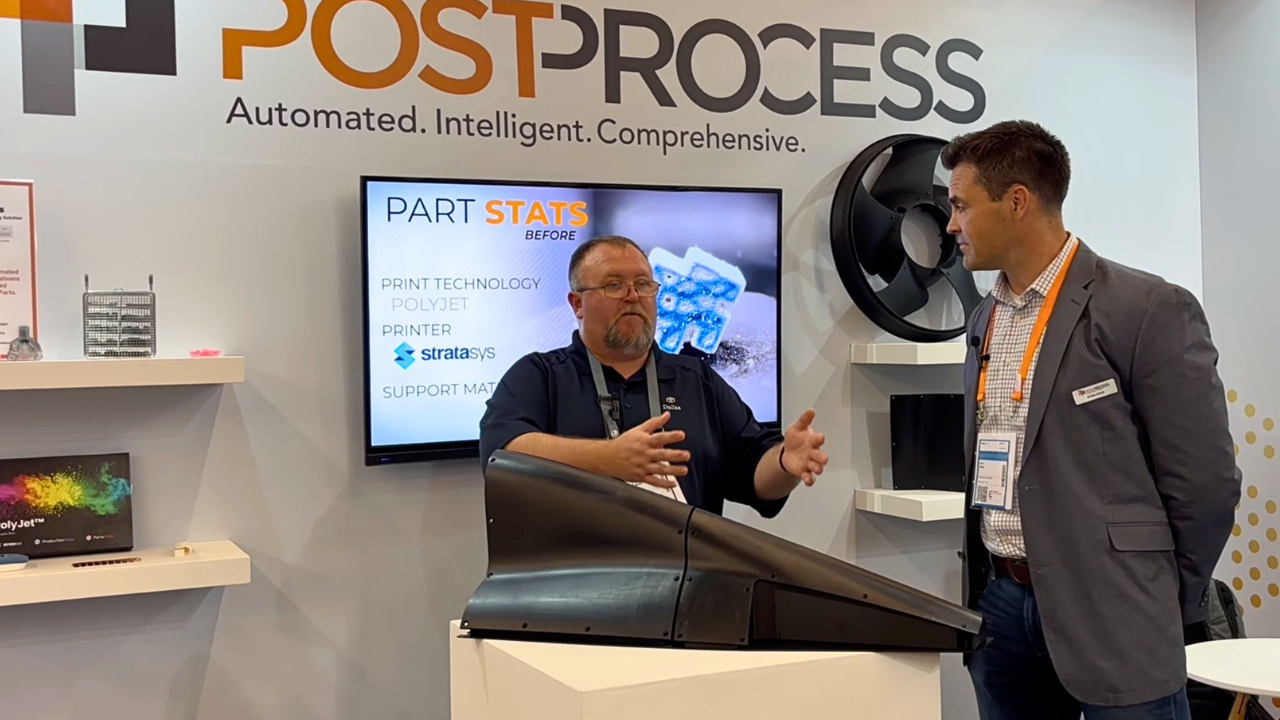
 At Toyota Production Engineering, Additive Manufacturing Engineer Dallas Martin and his team bridge the gap between design and manufacturing. They’re responsible for developing the fixtures, jigs, and supporting processes that help move programs from concept into production and keep assembly running smoothly.
With a lean team supporting high-throughput work within the additive facility, automation plays an important role in helping them keep pace and stay efficient.
To overhaul their post-printing workflows, Toyota adopted the PostProcess BASE and DEMI 4100 systems. Here is a look at how these automated solutions are transforming their operations.
Slashing FDM Processing Times with the BASE
Toyota utilizes Fused Deposition Modeling (FDM) extensively, operating a fleet of over 18 large-format FDM machines. However, their traditional post-processing step became a massive bottleneck. Previously, parts had to be washed in a dunk tank, placed out on a rack to dry, and then operators had to manually remove the excess SR30 support material. This workflow relied heavily on manual labor and oftentimes, took up to 48 hours to complete.
Integrating the PostProcess BASE FDM Support Removal Solution was described as a “home run” for the team. Automating the support removal step with the BASE solution drastically cut down turnaround times for the team.
“What used to take two days is now completed in just 15 minutes for small parts and 45 minutes for larger parts,” said Martin.
This significant improvement in efficiency allows engineers to receive parts faster, helping accelerate both prototyping and overall production timelines.
Safer, Automated SLA Resin Removal with the DEMI 4100
For Stereolithography (SLA) applications, Toyota utilizes large-format Stratasys Neo800 printers to handle substantial part sizes that are often required in automotive manufacturing. However, SLA post-processing posed a unique safety challenge – Toyota’s facility had strict safety regulations regarding flammable substances often used in conventional post-processing methods.
“We had to look for a solution that was a lot safer but was also automated,” said Martin.
Toyota turned to the PostProcess DEMI 4100 Resin Cleaning Solution to meet their safety requirements without sacrificing throughput. The system provided an automated, safer approach to resin removal that aligned with the facility’s operational standards.
Seamless Integration and Commonality
One of the standout benefits of running both the BASE and DEMI 4100 is the synergy between the two systems. Both machines utilize the exact same software interface, which creates a common process flow between FDM and SLA.
For Toyota’s operators, this commonality is a game-changer. It means less operational training and easier cross-training, as users don’t have to constantly switch between different controllers or memorize entirely different operating settings.
By adopting automated post-processing, Toyota Production Engineering continues to stay highly competitive and keep cutting-edge innovations moving quickly.
To hear more about Toyota’s experience with PostProcess, watch the full interview with Dallas Martin on our YouTube channel: Toyota Customer Testimonial | PostProcess BASE & DEMI 4100.